Designer insight
Everything You Need to Know Before Picking Your Countertops
When it comes to countertops, there’s a lot of details you should be thinking about — what use for what application, the pros and cons of each and what are the latest trends to keep up with the Jones. At Select, we don’t have a specific dog in the fight about which countertop material is better than another. What we have found over the years is that they all have different pros and cons, depending on who you’re talking to and who is representing which company.
Choosing Your Material: Aesthetics vs. Functionality
Your main contenders are granite, man-made quartz, and then some specialty stones — quartzite (not to be confused with man-made quartz), soapstone, marble, and a few other exotic materials.
When we go over options with clients, the conversation comes back to aesthetics versus functionality. On the aesthetic side, what you’re really looking for is what’s called movement — how much pretty swirls and speckling do you see in your countertop, versus how clean does it look.
Granite tends to have the most movement. It comes in different price groups A to E, from entry-level (A) to exotic (E). Your entry-level A or B granites while tending to have a lot of pattern it is a more consistent movement pattern throughout the piece — so if you see one 12″ x 12″ sample, that’s going to pretty much tell you what the whole slab looks like. When you get into the pricier granites, you’ll see more dramatic patterns flowing throughout the material, and at that level you really have to think carefully about which piece you want and where it goes in your kitchen or bathroom. For exotic granite especially, never purchase based off a small color chip — you need to go see the full slab in person at a distribution center or fabricator.
Man-made quartz tends to have less movement, or movement designed to mimic granite or marble. Major vendors like Silestone by Cosentino, Q Quartz by MSI, LG Viatera, and others are all mainly trying to replicate a marble look with different amounts of veining — those wide or narrow stripes of color running through the material. Cambria is another big player in the man-made quartz space, with very unique patterns that lean more toward mimicking granite, though they do offer some marble looks. With quartz, it’s also a good idea to see a full slab before committing, because the sample chips at a showroom are usually just highlighting one particular feature of the slab and not showing you the full picture.
Quartzite, Marble and other natural stones have different levels of movement and veining and absolutely should only be seen in person to fully see the patterns and luster of the material. At any reputable distribution center you will see some true art pieces and it never ceases to amaze me what mother nature has created in the earth.


Thickness: What the Numbers Mean
Countertops generally come in two thicknesses: 2 cm (roughly 3/4 of an inch) or 3 cm (roughly an inch and a quarter).
The 2 cm material tends to show up in contemporary applications or in prefab cabinet packages where a company advertises a marble or quartz countertop but is using thinner material to cut costs — so watch the fine print and make sure you’re comparing apples to apples.
Any fabricator should as a standard be fabricating your countertop at 3 cm thick as a minimum unless you are going for a contemporary look.
One feature that’s become a lot more popular is the extra-thick countertop edge. A standard 3cm countertop is used, but to create a more substantial look, fabricators will cut a piece of countertop material about 3 inches long and install it sideways along the edge — making it appear much thicker than it is actually.
There are two ways to make this work structurally:
- If you’re doing custom cabinetry, the cabinet manufacturer can build the drawer box faces slightly shorter, creating more clearance between the drawer and the countertop.
- Your installer can lay 3/4-inch plywood on top of the cabinetry to raise the countertop height, creating space for the applied edge piece.
You should be aware that this will increase the costs on your countertop depending on desired “thickness” and amount of material used. A way to create this without a huge increase is to install the extra thick edge of an the island while maintaining a standard height at your perimeter cabinetry. Particularly if you are doing a two-tone look.
Edge Profiles: From Simple to Exotic
Any time a countertop doesn’t die into a wall, you need to think about the edge profile.
- Eased edge — Your standard price point. Just a slight rounding of the corner so you don’t have a sharp outside edge.
- Round over or quarter bevel edge — A step up in elegance without a big jump in cost. Think of using this option for a slightly more refined look.
- Exotic profiles — If you want to go further, there are about 10 to 12 other edge profiles with varying curvatures, each at a higher price point.
Any good fabricator or designer will walk you through these options before fabrication begins.
One important note for islands: if you have an overhang with an outside corner, you want that corner to have more of a curve to it. Sharp corners at hip height can be a problem for adults, kids, and pets alike.
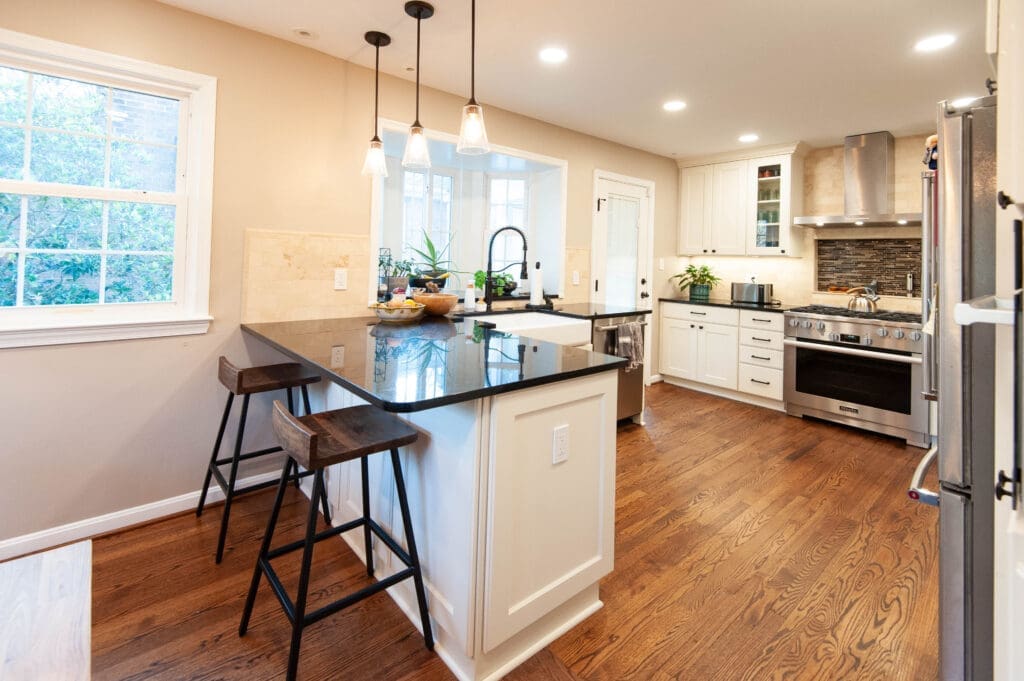


Island Overhangs: Getting the Dimensions Right
The overhang at an island countertop is something that comes up in every cabinetry design conversation, and for good reason.
- Standard cabinet height (finished height of 36” off the floor): You want a minimum of 12 inches of overhang but ideally 15 to 18 inches depending on your stool height and how much room you have.
- Bar top height cabinets (finished height of 42” off the floor): You can get away with a slightly smaller overhang, around 12 inches. Don’t go smaller than 12 inches, or you’ll be hitting your legs on the cabinetry every time you sit down.
Backsplash: What to Do (and What Not to Do)
For vanities, the standard approach is to use the same countertop material as a backsplash and side splashes installed at 4” tall so no water hits the drywall behind the sink. This would be at 3 cm thickness. The exception is when you are installing a shallow vanity. The cabinet will be 18 inches front to back instead of the standard 21 inches. In that case, a good fabricator or installer will cut the countertop backsplash and side splash down to 2 cm so your faucet and sink can be installed properly and any drain pop-up handle functions correctly.
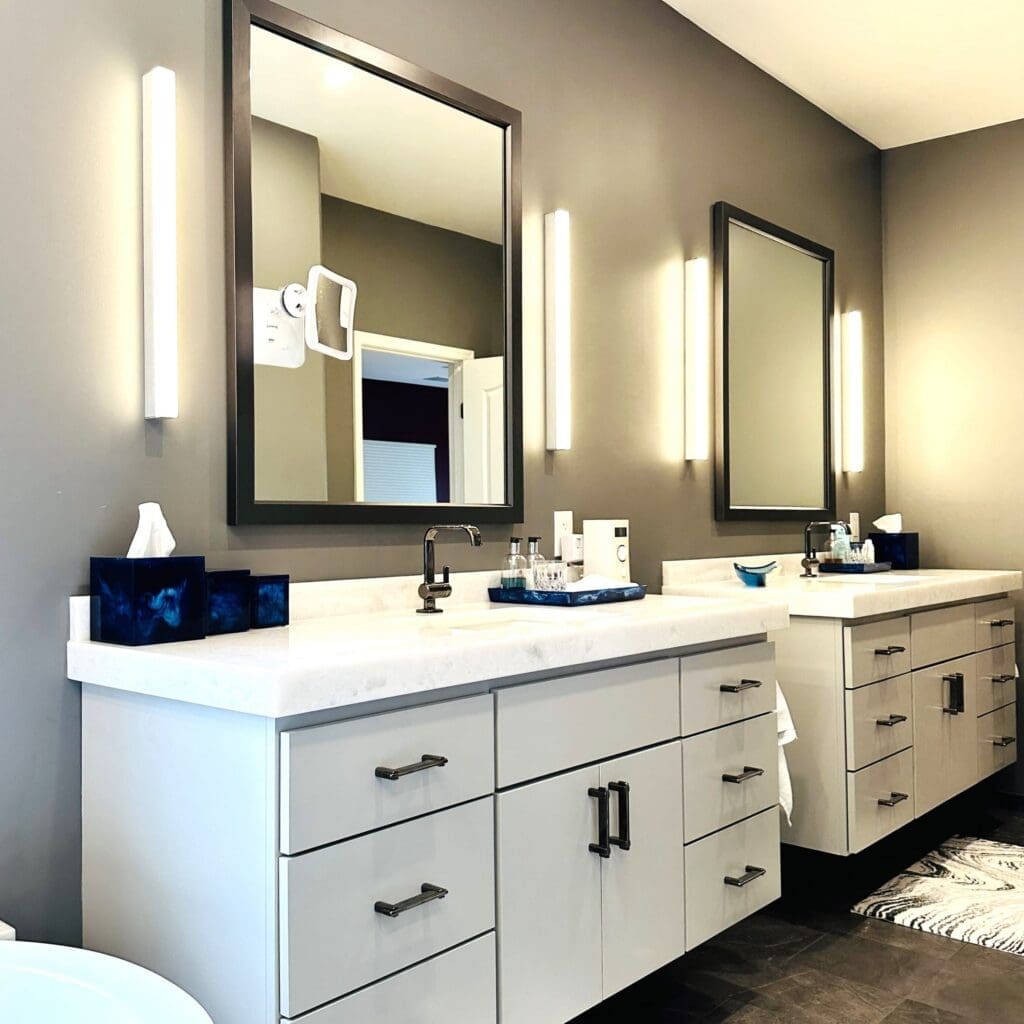


For kitchens, the thinking has shifted on backsplashes over the years. A good company these days generally wouldn’t be recommending a countertop material as the backsplash at 4” tall. You will see the current trend is either some sort of tile as an accent feature or as a more costly option, installing the countertop as a full height backsplash up to the bottom of the wall cabinetry.


What you’ll sometimes see — especially in retrofit situations — is a 4-inch countertop backsplash along the wall with tile installed above it. While it’s not the worst approach, it’s not ideal. Here’s why: your countertop is typically one color and your backsplash tile is a different one. When they’re on separate planes — countertop horizontal, tile vertical — those colors stay in their own distinct zones and the look is clean. When you wrap countertop material 4 inches up the wall and then tile above it, you end up with two competing colors on the same vertical surface, which can create a visual conflict. Unless you’re specifically going for that look, it’s something that’s largely fallen out of favor.
Surface Finishes: The Other Half of the Look
Most people spend all their time picking a material and a color, then forget entirely about the finish — which has a big impact on both how the countertop looks day to day and how much maintenance it requires.
The three most common options are polished, honed, and leathered. A polished finish is the classic high-gloss look — it really shows off the depth of color and movement in the stone, but it also shows fingerprints, water spots, and smudges more readily. A honed finish is matte, giving the stone a softer, more understated appearance — it hides everyday marks better but can be slightly more prone to staining on natural stone since it’s not as sealed at the surface. A leathered finish has a subtle texture to it, kind of like the surface of leather, and it’s become increasingly popular because it hides smudges well, feels great to the touch, and gives the stone a more organic, lived-in character. It tends to cost a bit more than polished or honed due to the additional fabrication work involved.
The finish is something to decide before fabrication — it’s not an afterthought. Bring it up with your fabricator the same time you’re discussing edge profiles.
Heat and Scratch Resistance: Know What You’re Working With
This is the functionality side of the aesthetics-versus-functionality conversation, and it’s where material choice definitely matters depending on how you cook.
Granite is one of the most heat-resistant materials you can put in a kitchen. As a natural stone formed under extreme heat underground, it can handle a hot pan set directly on it without damage — though using trivets is always a good habit to protect the finish long term.
Man-made quartz is a different story. Because it’s made with an epoxy (glue) binder excessive heat can melt or discolor the glue. You don’t want to be putting hot pans directly on quartz. If you cook heavily and you’re not someone who’s going to reliably reach for a trivet every time, this is worth factoring into your material decision, especially for countertops near your range or cooktop.
On scratch resistance, both granite and quartz are excellent for everyday use. Quartz rates slightly higher on the hardness scale, but in practical kitchen terms they’re both durable enough that normal use won’t be a concern. The same goes for quartzite, which is one of the hardest natural stones available. Marble, on the other hand, is softer and scratches more easily — another reason it requires more thought before going into a high-use kitchen.

Sealing and Maintenance: What You’re Signing Up For
This one doesn’t come up enough in the initial countertop conversation, and it should — because the difference in ongoing maintenance between materials is significant.
Man-made quartz requires essentially no maintenance. It’s non-porous by nature, so it doesn’t need sealing, doesn’t absorb liquids, and cleans up easily with soap and water. For busy households or anyone who doesn’t want to think about upkeep, this is a real advantage.
Granite needs to be sealed, though the frequency depends on the specific stone. Darker granites are generally denser and may only need resealing every three to five years. Lighter-colored granites — whites, creams, light grays — tend to be more porous and may need attention every one to two years. Your fabricator should seal it at installation, but plan on maintaining that over time. It is not a difficult proposition but just need to set a reminder to do it.
Marble requires the most diligence. It should be sealed at installation and resealed annually, and even a well-sealed marble countertop can etch — meaning acids like lemon juice, vinegar, or even some cleaning products can leave dull marks on the surface. This is a chemical reaction in the stone, and no sealer prevents it. Marble can absolutely work in a kitchen if you love the look and understand what you’re getting into, but go in with eyes open.
Quartzite, despite being a natural stone, is generally much denser than marble and generally needs less frequent sealing, though it still benefits from it at installation and periodically over time. You will find though that some Quartzite are even more porous than marble because of the different mountain it is cut from, so make sure you are consulting with your fabricator prior to purchasing.
What to Budget: Ballpark Pricing by Material
Getting exact countertop pricing is notoriously difficult — it varies by region, fabricator, slab availability and project complexity. But going into a showroom with no frame of reference puts you at a disadvantage. Here’s a rough installed cost range to orient yourself:
- Granite: $40–$100 per square foot installed for most grades, with exotic or rare stones going higher
- Man-made quartz: $60–$120 per square foot installed, depending on brand and pattern complexity
- Marble: $60–$150 per square foot installed; certain high-demand marbles like Calacatta can go significantly higher
- Quartzite: $70–$150 per square foot installed
For a typical kitchen, most homeowners in the DC metro area end up spending somewhere between $4,500 and $7,500 total once fabrication and installation are factored in. Bathrooms cost less simply because there’s less square footage involved or you find a remnant piece left over from a kitchen project that can be used.
A few things that push the price up regardless of material: complex layouts with lots of corners or angles, cutouts for undermount sinks and cooktops, upgraded edge profiles, and premium finishes like leathered or honed. Getting multiple quotes from fabricators is always worth doing as you will find pricing can vary 10 to 15 percent between shops for the same material.
A good designer and fabricator will walk you through all of these decisions — material, finish, edge profiles, overhangs, thickness, maintenance, and backsplash — before a single cut is made. The more you know going in, the better your end result.
703-866-4224
info@selectkitchenandbath.com